About Flow Table
Product Details:
| Minimum Order Quantity |
01 Piece |
| Power Supply |
230 Volts, 50 cycles, A.C. |
| Operation |
15 times in 15 seconds |
| Tamping rod |
16mm dia x 600mm long |
| Table Top |
76.2cm ( 30 inch. Dia) |
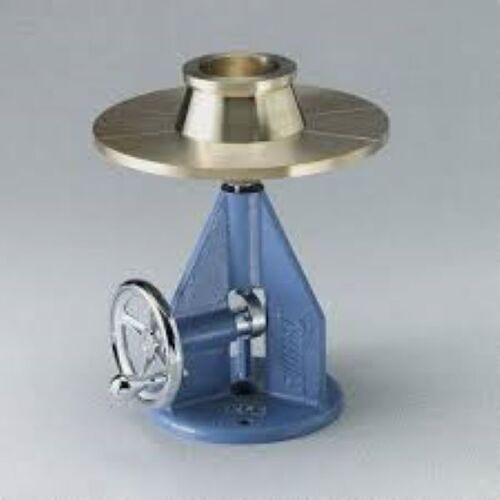
It is used for determining the flow of cement concrete. Consists of a steel table top 76.2cm ( 30 inch. Dia) Finely machined. The integral cast ribs are designed for support and strength. The stand is fabricated out of cast iron and is of study construction. Holes for mounting in foundations are drilled in the base plate. The ground and hardened steel cam is designed to fit and drop the table by 12.5mm. Electrically operated to raise and drop the table top. Supplied with one conical mould with two handles, 12cm height, having 17cm. Inside Dia. at the Top and 25cm inner dia. at the base.Designed for Accurate Consistency TestingThe Flow Table provides reliable measurements for concrete and cement mortars, ensuring precise evaluations of material workability. Its sturdy construction and standardized process make it a trusted choice for laboratory and field testing within civil engineering.
Built to Last and Easy to MaintainIts powder painted finish and rust inhibitor coating enhance durability, while the corrosion-resistant tabletop supports consistent, long-term use. Cleaning is hassle-free, thanks to the smooth surfaces and quality material choices like brass and mild steel.
Manual Operation for Maximum ControlManual lifting with a handle allows the operator to regulate table drops precisely, meeting both IS 1199 and ASTM C230 standards. The hand-operated mechanism ensures the table is simple to operate and maintain, with no need for electrical power or computerized controls.
FAQ's of Flow Table:
Q: How is the Flow Table used to determine the consistency and workability of concrete or cement mortar?
A: The Flow Table method involves placing a prepared sample in the supplied brass cone mould on the table. After removing the cone, the table is manually lifted and dropped a specified number of times (15 or 25 standard drops) using the handle and counter mechanism. The spread of the sample is then measured to determine consistency and workability.
Q: What standards does the Flow Table comply with for testing procedures?
A: This equipment is manufactured according to IS 1199 and ASTM C230 standards, ensuring reliable and repeatable laboratory testing methods for concrete and mortar consistency.
Q: When should the Flow Table be used during concrete or mortar evaluation?
A: Civil engineers and lab technicians typically use the Flow Table during initial mix evaluations or quality control stages, before casting or application. This helps assess workability and adjust water or additive content as needed.
Q: Where is the Flow Table most commonly used and who can benefit from it?
A: The Flow Table is frequently utilized in civil engineering laboratories, construction sites, and quality control facilities. It's beneficial for researchers, contractors, and technical staff involved in concrete formulation and material testing.
Q: What accessories are included with the Flow Table for standard testing?
A: Standard accessories include a brass cone form (with specified dimensions), a tamper, and a wooden handle, allowing users to perform consistent and accurate sample preparation and testing as per methodology.
Q: How does the manual lifting mechanism work and what is its benefit?
A: The manual lifting handle operates the table by allowing controlled, smooth lifting and dropping, using a counter for drop count. This provides greater accuracy and repeatability while reducing reliance on electrical power, ensuring portability and ease of maintenance.
Q: What is the process for cleaning and maintaining the Flow Table after use?
A: After testing, the powder coated, corrosion resistant surfaces can be easily wiped clean. Regular maintenance involves checking for wear on moving parts and ensuring the brass cone and tamper are free from residue, supporting long-term, accurate performance.
 Send Inquiry



 Send Inquiry


 Send Inquiry