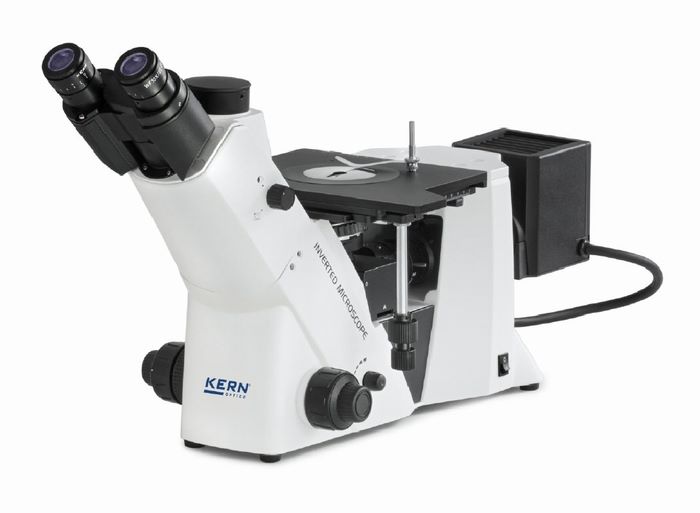
About Metallurgical Inverted Microscope
Specification:
Magnification Range:20x to 400 x (Standard) 0
Observation Head:Binocular 45 with interpupillary and diopter adjustment
Stand:Sturdy and Durable pressure Die cast Aluminium stand.
Mechanical Stage:Co-Axial low drive double plate mechanism system travel on ball bearing guide ways.
Focusing System:Co-axial coarse & fine mechanism system with ball bearing guide ways.
Epi-Illumination:Built in base 12V-50W Halogen lamp with light intensity control system.
Quadruple Nose Piece:A precision mechanism ensures the accuracy andoptical alignment of the system.
Filters:Green & Blue.
DIN-LWD Objectives:M4 x M10x, M20x & M40x (SL). Anti Fungal & infinity corrected.
Eye Pieces:5x & 10x Paired.
Extra wide field, Anti fungal & Anti reflected
Exceptional Optics and Precision EngineeringDesigned to support advanced metallographic studies, this inverted microscope integrates high-quality Infinity Plan Achromatic Objectives and a wide field 10x eyepiece, ensuring bright, flat-field images across the viewing area. The robust metal construction enhances stability during sensitive analyses, while the trinocular head allows for both direct observation and camera use, supporting documentation and research workflows.
User-Friendly Features for Enhanced ProductivityThis microscope's mechanical stage, with its generous 180mm x 155mm surface and smooth X-Y controls, makes sample manipulation effortless. Coarse and fine coaxial focusing enables rapid yet precise adjustments, while the 30mm focusing range accommodates a variety of specimen thicknesses. With adjustable brightness from the 6V/30W halogen lamp and long working distance condenser, users can adapt to diverse imaging needs.
FAQ's of Metallurgical Inverted Microscope:
Q: How is the Metallurgical Inverted Microscope typically used in industrial research?
A: This microscope is widely used for the observation, analysis, and research of metallographic structures, particularly in electronics, metallurgy, and precision machinery industries. Its design allows users to examine large or irregular samples without disruption.
Q: What benefits does the robust metal construction provide?
A: The strong metal body ensures stability during operation, reducing vibrations and enhancing image clarity, which is essential for detailed metallurgical analyses.
Q: When should the optional polarizer and analyzer be utilized?
A: The polarizer and analyzer accessories are ideally used when detailed analysis of specimen structures involving light polarization is required, such as identifying phase differences in metals or examining components in microelectronics.
Q: Where can images or videos be captured using this microscope?
A: A dedicated photo/video port on the trinocular viewing head allows for easy attachment of digital cameras, making it simple to document observations for analysis, reporting, or teaching.
Q: What is the process for adjusting focus throughout various sample heights?
A: Coaxial coarse and fine focus knobs provide smooth, incremental adjustments over a 30mm range, accommodating both thin and thick samples while maintaining sharp focus.
Q: How does the mechanical stage enhance sample observation?
A: The 180mm x 155mm rectangular mechanical stage offers ample space and precise X-Y movements, allowing accurate positioning of samples and more efficient examination workflows.
 Send Inquiry



 Send Inquiry


 Send Inquiry